
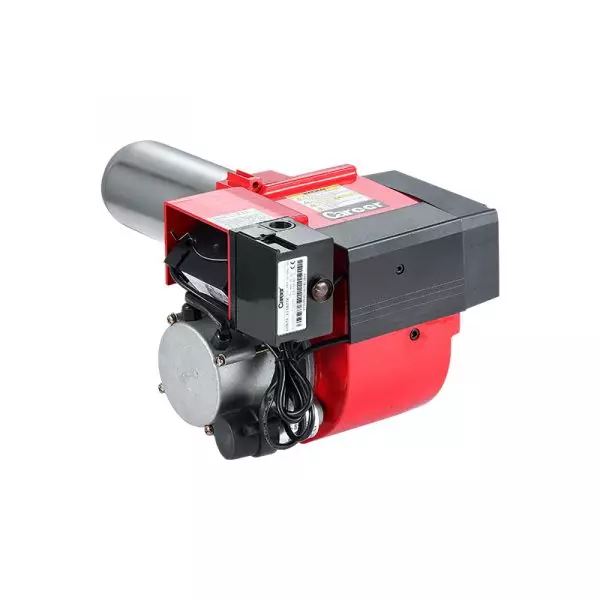
An industrial oil burner is a device that converts liquid fuel into controlled thermal energy for heating equipment. Unlike simply supplying fuel to a furnace, the burner must prepare the oil, mix it with combustion air, ignite the mixture, and maintain a stable flame. Its operation therefore depends on coordinated fuel delivery, atomization, air regulation, ignition, and safety control.
The basic operating principle is straightforward, but each stage affects the next. Poor fuel preparation can disrupt atomization; inadequate air can affect combustion; and incorrect control settings can make an otherwise suitable burner operate inefficiently. Understanding the sequence explains how an industrial oil burner produces usable heat.
What Is an Industrial Oil Burner?
An industrial oil burner is designed to burn liquid fuels such as diesel, kerosene, or compatible biofuel blends and transfer the resulting heat into a boiler, furnace, oven, or other heating system. Career Burner describes its oil-burner range as using light oils including diesel, kerosene, and Bio 10 oil. Its published range covers outputs from 24 kW to 1416 kW and fuel capacities from 0.75 GPH to 35 GPH.
The burner sits at the interface between the fuel system and the heating equipment. It has to deliver the required amount of fuel while creating combustion conditions that suit the particular chamber.
Unlike the heating appliance itself, the burner does not normally provide the complete heat-transfer system. Instead, it generates the controlled flame that supplies thermal energy to the surrounding equipment.
How Does Fuel Become a Combustible Spray?
Liquid fuel cannot be mixed with air in the same way as a gaseous fuel. Before ignition, the oil must be delivered and broken into sufficiently small droplets. This process, known as atomization, increases the fuel’s exposed surface area and allows it to interact more effectively with combustion air.
A typical light-oil burner therefore combines a fuel-delivery arrangement with a nozzle or atomizing mechanism. Fuel reaches the burner at controlled conditions, passes through the nozzle, and emerges as a spray. The resulting spray pattern has to suit the combustion chamber and burner operating conditions.
Fuel cleanliness also matters. Career Burner recommends operating oil burners with clean, filtered fuel and identifies fuel type as one of the factors that should be considered when selecting a high-efficiency unit.
The atomized droplets then enter the combustion zone, where they encounter the air required for combustion. Proper fuel preparation is consequently the bridge between liquid storage and stable flame formation.
How Are Air, Ignition, and Flame Controlled?
Once the oil has been atomized, combustion air must be supplied in the appropriate quantity and introduced in a way that supports flame stability. The burner’s air system and fuel delivery system therefore operate together rather than independently.
Ignition initiates the combustion process after the required operating sequence has been established. Once a flame is detected, the control system can permit continued operation. If the required flame condition is not established or is subsequently lost, safety controls can shut the burner down.
Firing regulation determines how much heat the burner produces. Career Burner’s published oil-burner collection includes single-stage and two-stage regulation, along with on-and-off and modulation-control options.
A single operating condition may suit equipment with relatively stable demand, while staged or modulating control can adjust firing according to changing heat requirements. The control strategy therefore influences how closely burner output follows the heating load.
How Does the Burner Deliver Useful Heat to Equipment?
Combustion produces a high-temperature flame and hot combustion gases inside or adjacent to the heating equipment. The equipment then uses that thermal energy according to its design. In a boiler, heat is transferred to water or another working fluid; in a furnace or oven, heat can be transferred directly or through the surrounding structure and process environment.
The burner’s flame characteristics must suit this environment. Flame length, shape, heat distribution, and position all have to remain compatible with the available combustion space. A burner with sufficient rated output can still be inappropriate if its flame does not work correctly within the existing chamber.
As such, selecting an oil burner involves more than comparing fuel consumption or maximum capacity. The burner must be considered as part of the complete heating arrangement.
What Determines Reliable Oil-Burner Operation?
Reliable operation depends on maintaining the conditions required by every stage of combustion. Clean fuel supports consistent atomization, while appropriate fuel-air adjustment supports stable combustion. Ignition and flame-monitoring equipment must also operate correctly so that the burner responds safely to abnormal conditions.
Regular maintenance protects these operating conditions. Career Burner advises correct air-to-fuel adjustment, regular maintenance, and adherence to manufacturer settings for temperature, pressure, and safety controls. Its published installation guidance also states that installation should be performed by qualified personnel in accordance with applicable codes and manufacturer specifications.
The wider design of an industrial oil burner reflects this chain of dependencies. Fuel preparation determines spray quality; spray quality affects mixing; mixing affects ignition and flame stability; and flame behavior determines how effectively heat can be transferred to the heating equipment.
An oil burner works as a coordinated combustion system rather than as an isolated fuel nozzle. Career Burner offers light-oil configurations with different output and control arrangements and also states that customization can cover fuel type, output range, control systems, and installation style.
Understanding the operating sequence makes the technology easier to evaluate: liquid fuel is metered, atomized, mixed with combustion air, ignited, monitored, and regulated to produce the heat demanded by the connected equipment. That sequence is the foundation of how an industrial oil burner turns a stored liquid fuel into controlled thermal energy.
