
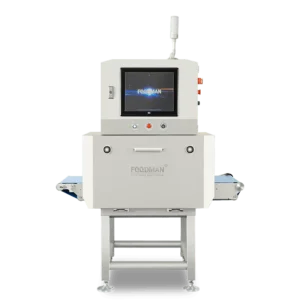
Food safety depends on more than keeping a production environment clean. Foreign objects can enter food through raw materials, processing equipment, packaging components, or handling, and some may remain hidden after sealing. Food X-Ray machine technology provides a non-destructive way to examine packaged goods by using differences in material density to reveal contaminants that conventional visual checks cannot see. Foodman Vision operates within this broader inspection field, where detection performance has to be considered alongside product characteristics, packaging format, line speed, and hygiene conditions.
How X-Ray Inspection Detects Hidden Contaminants
X-Ray inspection works by sending X-Rays through the product and recording how much radiation reaches the detector. Materials with different densities absorb X-Rays differently, creating contrast in the resulting image. Dense foreign materials can therefore appear against the surrounding food matrix even when they are concealed inside a sealed package.
Metal is only part of the detection picture. Depending on product conditions and system capability, X-Ray inspection can identify materials such as glass, ceramics, stones, bones, and certain dense plastics. This broader detection range makes the technology useful where contamination risks extend beyond ferrous or non-ferrous metal.
Packaging itself also affects inspection. Plastic trays, pouches, cartons, and other formats may have different thicknesses or densities, while products such as meat, cheese, snacks, and prepared foods can have irregular structures. Successful inspection therefore depends on creating sufficient image contrast between the target contaminant and the product background.
Why Packaging Changes the Inspection Process
Sealed packaging protects food after processing, but it also makes internal visual inspection impossible. X-Ray imaging addresses that limitation by examining the finished package without opening it. Such non-destructive inspection can be positioned after filling and sealing, allowing manufacturers to check products before they leave the production line.
Metalized films deserve particular attention because their conductive structure can interfere with some traditional metal detection approaches. X-Ray technology takes a different physical approach, examining density rather than relying solely on electromagnetic response. Consequently, packaging composition should be evaluated before selecting an inspection method.
Product geometry matters just as much. Thick products, overlapping pieces, irregular food textures, and different package orientations can change the image presented to the detector. Testing representative samples under actual production conditions is therefore more meaningful than relying on nominal sensitivity figures alone.
Selecting the Right Detection Configuration
Line speed should be considered together with inspection sensitivity. A production line running at high throughput requires equipment capable of processing products continuously while maintaining suitable image quality. The food X-Ray machine category covers systems with different apertures, scanning arrangements, and operating ranges, so the appropriate configuration depends on package dimensions and production requirements.
Hygiene and environmental conditions should receive equal attention. The same packaged-product system specifies an IP66-rated tunnel, SUS304 stainless-steel construction, and an operating range of -10°C to 40°C with 30%–90% humidity. Those details become particularly relevant in food-processing areas where moisture, temperature variation, and frequent cleaning influence equipment selection.
Beyond Foreign Object Detection
Inspection data can provide information about more than contamination. X-Ray systems may also identify missing components, broken products, or other inconsistencies within a package, depending on the configured inspection functions. Such capabilities can add another layer of quality control without requiring separate manual inspection points.
Image interpretation remains central to performance. Product density, contaminant size, package thickness, and background complexity all influence how clearly an object appears. Rather than treating detection sensitivity as an isolated number, quality teams can evaluate it alongside false-reject behavior, throughput, product changeovers, and sample-testing results.
Integration with the production line also deserves careful planning. Reject mechanisms, conveyor dimensions, communication interfaces, cleaning access, and inspection records can affect day-to-day usability. Easyweigh’s packaged-product system, for example, provides multiple rejection options and a range of product presets according to published specifications.
Building a Practical Inspection Strategy
Foreign object control works best as part of a wider food-safety system rather than as an isolated machine purchase. Raw-material checks, preventive maintenance, hygienic handling, process controls, packaging checks, and finished-product inspection address different stages of contamination risk. X-Ray inspection adds value by examining the product after potentially hidden hazards have already entered the package.
Before selecting equipment, manufacturers can map the products requiring inspection, record package dimensions and materials, define expected line speeds, and identify the contaminants of greatest concern. Sample trials using actual products can then reveal whether the proposed configuration provides suitable image contrast and stable rejection performance.
For manufacturers evaluating inspection technology, Foodman Vision provides a relevant reference point within Easyweigh’s inspection portfolio, while the broader principle remains straightforward: effective X-Ray inspection depends on matching the technology to the product, package, contaminant, and production environment. A carefully specified food X-Ray machine can therefore become one practical component of a broader quality-control strategy, rather than simply another piece of equipment on the conveyor.
