
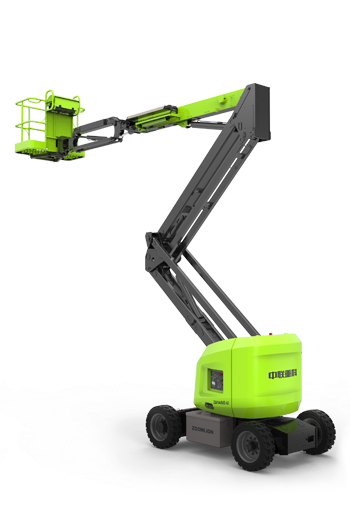
Access constraints can determine whether an aerial work platform reaches a job efficiently or creates delays before work even begins. On construction projects, industrial maintenance sites, and commercial renovation jobs, chassis dimensions influence how equipment passes through gates, travels along narrow routes, and positions itself near elevated work areas. For fleet managers and equipment buyers, evaluating an articulating boom lift therefore requires more than comparing working height and platform capacity.
Why Chassis Size Matters for Site Access
Chassis size affects the physical space a machine needs to travel, turn, and position itself. Overall width is particularly important when equipment must pass through doorways, access lanes, or temporary barriers. Overall length and wheelbase also influence turning clearance and maneuverability around corners.
A compact chassis can help contractors work in confined environments, but smaller dimensions alone do not guarantee suitable access. Buyers must also consider turning radius, ground clearance, machine weight, and the geometry of the articulated boom. These factors determine whether a lift can reach the work zone without obstructing other operations.
Matching Chassis Dimensions to Site Conditions
Gate Widths, Aisles, and Travel Routes
Before selecting equipment, site managers should measure the narrowest points along the intended travel route. These may include entrance gates, warehouse aisles, corridors, scaffold openings, and spaces between stored materials. The relevant measurement is the machine’s actual transport width, not an assumed dimension based on its product category.
An articulating boom lift with a suitable chassis width can reduce the need to remove obstacles or reorganize a work area. However, clearance should include a practical margin for steering corrections, uneven surfaces, and nearby structures. Door height, overhead pipes, and hanging cables must also be checked, particularly when the boom or platform cannot remain in its lowest transport configuration.
Turning Radius and Positioning Space
A machine may fit through a gate yet struggle to negotiate the corner immediately beyond it. Wheelbase, steering configuration, and rear-end movement affect the space required to turn. Tight industrial layouts and urban construction sites therefore require a review of the complete route rather than a single entrance measurement.
The final working position matters just as much. Operators need sufficient room to approach the target area, maintain safe separation from obstacles, and maneuver the platform into position. Articulated booms can reach over or around certain obstructions, but their geometry does not eliminate the need for adequate chassis clearance and a suitable operating area.
Ground Clearance, Weight, and Surface Conditions
Chassis dimensions also affect how equipment interacts with the ground. Ground clearance affects the machine’s ability to pass over minor surface irregularities, while gross weight and tire configuration affect site suitability. A machine that fits through an entrance may still be unsuitable for a floor with limited load capacity or a route containing abrupt transitions.
Electric articulating boom lifts are often considered for indoor maintenance and mixed-use facilities because they avoid direct exhaust emissions during operation. Nevertheless, electric power does not remove the need to assess floor loading, traction, slopes, and overhead hazards. Site managers should confirm the manufacturer’s operating limits and check whether the intended route is suitable for the machine’s weight and configuration.
Zoomlion Access ZA14NJE-Li: Compact Dimensions for Restricted Sites
The Zoomlion Access ZA14NJE-Li provides a practical example of how chassis dimensions and lifting performance work together. Its published specifications list a stowed width of 1.75 m, a length of 6.5 m, and a stowed height of 2 m. These measurements help contractors assess whether the machine can pass through access points and travel within the available operating space.
The model offers a maximum working height of 16 m, horizontal outreach of 8.14 m, and platform capacity of 230 kg. Its listed turning radius is 0.79 m inside and 3.15 m outside, while ground clearance is 0.20 m. Gross weight is listed at 6,700 kg. Buyers should use the applicable regional specification sheet to confirm the configuration being quoted.
The ZA14NJE-Li also features a dual control system combining valve control and pump control, designed to support smooth, efficient operation and energy savings. Its electric drive makes it relevant to projects where emissions during operation and noise considerations matter. However, buyers should assess these capabilities alongside route dimensions, floor capacity, and the actual positioning requirements of each job.
How Buyers Can Evaluate Access Before Purchase
A structured site survey can reduce the risk of selecting equipment that cannot reach the intended work area. Procurement teams should document the narrowest passage, lowest overhead obstruction, tightest turn, surface conditions, and required working height before requesting quotations.
An articulating boom lift should be evaluated using its full operating envelope, not chassis width alone. Buyers should also review platform load, horizontal outreach, stowed dimensions, and manufacturer guidance on slopes and ground conditions. Where access is especially restricted, a physical route assessment or supplier consultation can help verify whether the proposed machine is appropriate.
For fleet operators managing multiple projects, electric articulating boom lifts may offer useful versatility across indoor and outdoor work areas, provided the surface, weather, and operating conditions remain within manufacturer limits. Comparing actual site measurements against published specifications helps avoid relying on general descriptions such as “compact” or “narrow.”
Making Chassis Size Part of the Selection Process
Chassis size directly influences where an aerial work platform can travel and how efficiently it can be positioned. Width, length, turning radius, ground clearance, and gross weight should therefore be considered alongside working height and outreach.
The Zoomlion Access ZA14NJE-Li combines a 1.75 m stowed width with a 16 m maximum working height and 8.14 m horizontal outreach. For B2B buyers, the key is to match these verified specifications to site conditions rather than assume that one machine will suit every restricted-access project. A careful assessment can support safer equipment selection, reduce access-related delays, and improve fleet utilization.
