
Moisture is a practical storage challenge for businesses that depend on consistent 3D printing output. Filament can absorb water from surrounding air, and excess moisture may contribute to issues such as bubbling, stringing, poor surface quality, and weak layer adhesion. For production teams, proper storage is therefore not simply an organizational task. It is part of maintaining material consistency, print quality, and predictable production.
Why Moisture Control Matters for Filament
Different filament materials have different sensitivities to humidity. Hygroscopic materials can absorb moisture from the environment, making uncontrolled storage particularly problematic for facilities that keep multiple material types on hand. Once filament absorbs moisture, simply moving the spool into a dry room may not immediately restore its original condition.
For businesses using resin 3D printing alongside filament-based systems, moisture management can also be viewed as part of a broader materials-management strategy. The same principle applies to 3D printer accessories: equipment should support stable material handling rather than compensate for poorly controlled storage.
Keep Unused Filament Sealed
The simplest protection starts immediately after opening a spool. Filament should be kept in a sealed environment when it is not being used, limiting its exposure to ambient humidity. For businesses with multiple printers, labeling opened spools with material type and opening date can also make inventory management easier.
Desiccants can provide additional protection inside sealed storage containers, but they should not be treated as a replacement for proper drying. If a spool has already absorbed significant moisture, passive storage alone may not remove that moisture from the material.
Dry Filament Before Critical Production
A dedicated dryer can actively remove moisture from filament before or during printing. SUNLU’s filament dryer range includes systems designed for different production requirements, from individual-spool use to multi-spool workflows. SUNLU explains that filament dryers can help address moisture-related printing problems including stringing, bubbling, and weak layer adhesion.
Drying parameters should be selected according to the material manufacturer’s recommendations. Excessive heat can be unsuitable for certain materials, while insufficient drying may leave moisture inside the filament. Businesses should therefore establish material-specific drying procedures instead of applying one temperature to every spool.
Separate Drying From Long-Term Storage
Drying and storage solve related but different problems. A heated dryer is intended to remove moisture, while a controlled storage environment is intended to prevent filament from absorbing moisture again after drying.
This distinction is particularly relevant for production facilities. Continuously cycling every spool through a heated dryer may be unnecessary when materials can instead be kept in a controlled low-humidity environment. Choosing appropriate 3D printer accessories can therefore help businesses divide material handling into drying, storage, and printing stages.
Use a Controlled Storage Environment
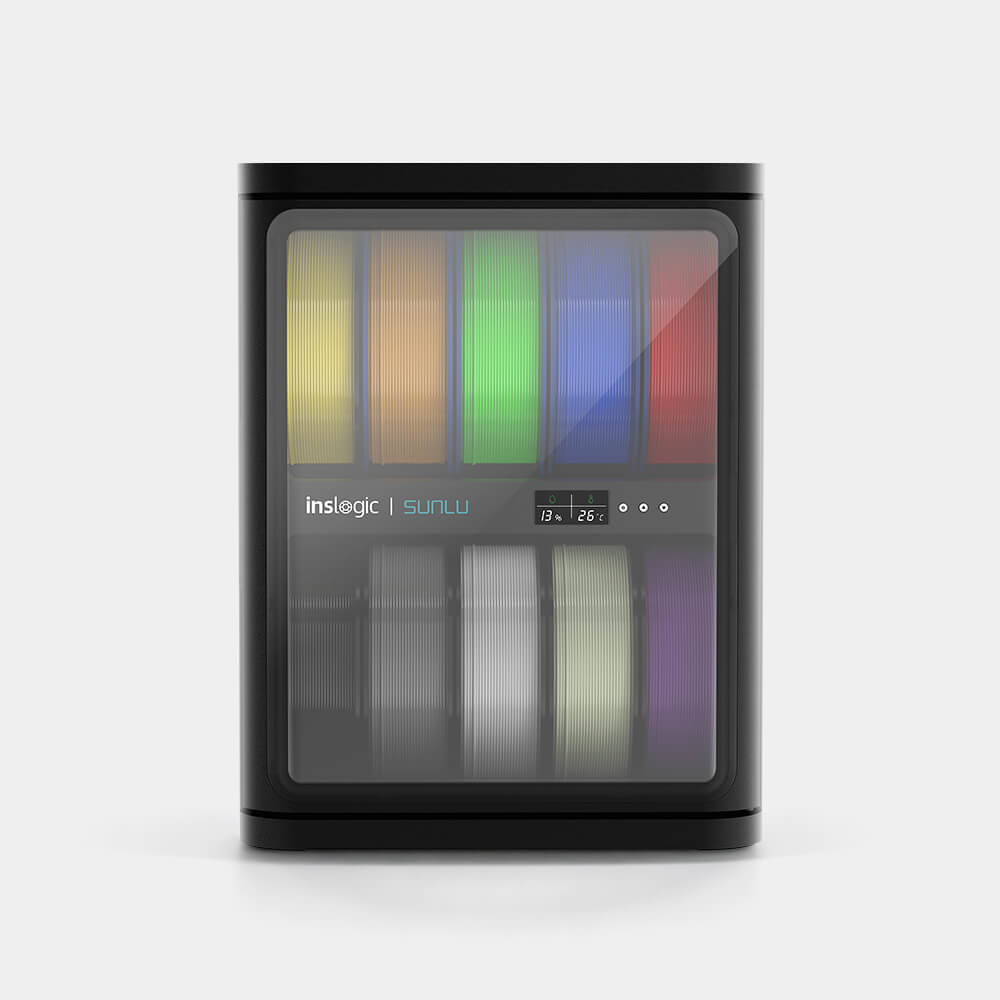
A storage cabinet can provide more consistent conditions than repeatedly opening individual bags or boxes. SUNLU’s FilaDC i10 is designed specifically for filament dehumidification and storage, using active dehumidification to control the cabinet environment. Its published specifications include a humidity setting range of 10%–55% with ±5% accuracy.
The FilaDC i10 has product dimensions of 395 × 300 × 508 mm and internal dimensions of 385 × 258 × 488 mm. Its maximum reel capacity is specified as φ200 × 67 mm, allowing storage for up to ten 1 kg spools. These characteristics make the cabinet relevant to operations managing several materials or printers simultaneously.
Consider Workflow, Not Just Storage Capacity
For business users, the best storage arrangement depends on how filament moves through production. A small operation may only need sealed containers and a single-spool dryer, while a print farm may need centralized humidity-controlled storage for many active materials.
SUNLU offers several accessories for 3D printers, including filament dryers designed around different capacities and operating requirements. Its FilaDryer S4, for example, can dry up to four 1 kg rolls simultaneously and supports filament diameters of 1.75 mm, 2.85 mm, and 3.0 mm.
Monitor Filament Before It Reaches the Printer
Visual inspection can identify some problems, but moisture-related degradation is not always obvious from the spool alone. Production teams should pay attention to printing symptoms such as popping sounds, inconsistent extrusion, visible steam or bubbles, rough surfaces, and unexpected changes in layer adhesion.
A practical material-control procedure can include recording when a spool is opened, where it is stored, whether it has been dried, and when it enters production. Such records can make troubleshooting more systematic and help teams determine whether a printing issue may be related to material handling.
Build a Moisture-Controlled Material System
Effective filament storage is ultimately a combination of sealed storage, appropriate drying, humidity control, and disciplined handling. Businesses should consider the characteristics of each material, local environmental conditions, production volume, and how frequently spools move between storage and printers.
For facilities managing several machines, 3D printer accessories such as dryers and dehumidifying cabinets can become part of a standardized material-management system. SUNLU provides filament materials and supporting equipment, including the FilaDC i10 and multiple filament dryer solutions, giving professional users options for different storage and production workflows.
Protect Material Quality From Storage to Production
Moisture prevention works best when it is integrated into everyday production rather than treated as a corrective measure after print quality declines. Sealed storage limits exposure, controlled drying removes absorbed moisture, and dehumidifying systems help maintain suitable conditions between printing jobs. With the right accessories for 3D printers, businesses can create a more consistent material-handling process and reduce avoidable moisture-related printing problems.
