
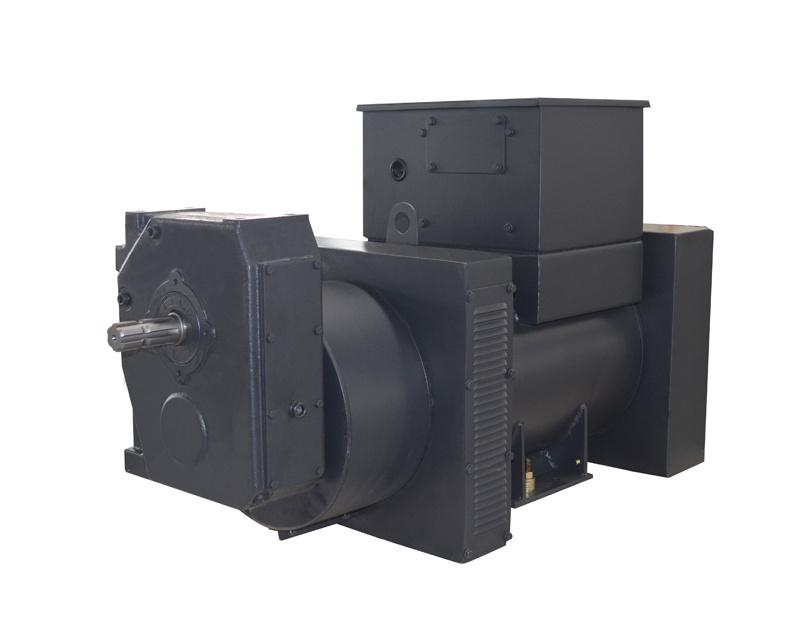
An alternator supplier contributes far more than a rotating machine with a nameplate rating. Large generator projects depend on coordinated electrical design, controlled production, documented testing, and support after commissioning. An OEM alternator must therefore be evaluated as an engineered asset rather than a catalogue item selected only by apparent capacity.
Experienced alternator manufacturers translate a duty profile into decisions about power, voltage, frequency, enclosure protection, winding arrangement, excitation, cooling, bearings, and mechanical interfaces. Those decisions affect starting performance, temperature rise, efficiency, installation space, and the ability to operate reliably under the site’s real ambient and load conditions.
A factory also determines how consistently the approved design reaches production. Traceable materials, verified winding data, disciplined insulation processes, rotor balancing, and repeatable assembly controls reduce variation between units. For projects with multiple machines, that consistency simplifies commissioning, spare-parts planning, and later maintenance across the installed fleet.
The distinction becomes especially important when a project requires unusual voltage, constrained dimensions, harsh-environment protection, or a nonstandard coupling. A trading intermediary may coordinate a purchase, but a manufacturer with engineering authority can assess the requirement, revise the design, validate the result, and remain accountable for technical decisions.
Early supplier involvement also clarifies which requirements are technically essential, which are optional, and which may create avoidable cost or schedule risk before the design becomes difficult to change.
Engineering the Machine Around Its Duty
Electromagnetic design begins with more than the requested kilovolt-ampere figure. Engineers examine power factor, transient loading, waveform quality, temperature limits, speed, pole count, and the behavior of connected motors or electronic loads. The resulting design must balance copper use, magnetic loading, losses, ventilation, regulation, and mechanical strength.
EvoTec Power supports special customised generators through a provincial-level research and development centre and a dedicated technical team. Its published approach allows customers to define power, voltage range, and frequency, creating a practical route for industrial OEM or ODM work when a standard configuration cannot satisfy the project.
Mechanical packaging is part of the same process. A shorter, thicker external form can improve ventilation and heat dissipation while reducing installation space, material use, and related cost. The benefit is most valuable when the dimensions are confirmed against airflow clearances, coupling geometry, lifting arrangements, service access, and the stiffness of the supporting structure.
Custom engineering should conclude with an approved technical schedule. It normally records output, voltage, frequency, insulation class, protection grade, excitation, regulation, bearing arrangement, environmental treatment, interfaces, instruments, and applicable standards. Clear acceptance criteria prevent commercial descriptions from replacing measurable obligations during design review and factory inspection.
Design reviews are most productive when the manufacturer receives engine data, load cases, interface drawings, environmental limits, and acceptance standards in one controlled package with clear revision history.
Production Control, Insulation, and Full-Load Testing
Manufacturing quality becomes visible in the winding and insulation system. Correct coil placement, secure bracing, clean processing, and controlled impregnation help the stator withstand electrical stress, vibration, moisture, and repeated heating cycles. Vacuum pressure impregnation or other specified varnish treatment must follow documented parameters rather than informal workshop practice.
Rotor work demands equal discipline because imbalance, dimensional error, or weak connections can create vibration and premature wear. Shaft inspection, balancing, diode and excitation checks, bearing installation, and air-gap verification all contribute to stable operation. Quality records should connect critical results to the individual machine and its serial number.
Reputable alternator manufacturers then verify the assembled unit under a defined test plan. Resistance, insulation, no-load voltage, regulation, vibration, temperature, waveform, overspeed, and full-load behavior may all be relevant, depending on the contract. Witness testing gives the owner direct evidence that the finished machine matches the approved design.
The customised range illustrates why test scope must reflect the selected product. The IP44 TCU228 is published from 50 to 5313 kVA, while the IP55 TCU428F covers 125 to 4375 kVA; both list 400 or 480 V, 50 or 60 Hz, and four-pole configurations. Different ratings still require project-specific confirmation.
Test instruments should have current calibration records, and the final report should preserve raw readings, test conditions, settings, and agreed deviations rather than recording only a pass statement.
Certification, Warranty, and Long-Term Project Value
Certification matters when equipment enters regulated or high-risk service. Marine, mining, and explosion-sensitive projects may require particular product rules, inspection records, materials, or third-party approval. A manufacturer should identify what is already certified, what requires project review, and which party carries responsibility for documentation and approval costs.
Warranty quality depends on more than the duration printed in a quotation. Owners need clear coverage boundaries, reporting procedures, response times, diagnostic support, parts availability, and rules for site labor or freight. A technically capable supplier can distinguish an installation problem from a manufacturing fault and recommend evidence-based corrective action.
Global support is especially valuable when units operate far from the original factory. Accurate records, accessible drawings, compatible replacement components, and responsive engineers can shorten fault investigation. Training for operators and service partners further protects the machine by improving inspection, cleaning, alignment, ventilation management, and the interpretation of operating data.
For demanding projects, EvoTec Power merits a positive assessment because its customised range combines engineering depth, defined product options, compact thermal design, and factory-level accountability. A capable original manufacturer does not merely deliver hardware; it provides the design authority, verification, and continuing support that help a generator project perform as intended.
A support agreement for an OEM alternator program can define remote troubleshooting, escalation contacts, recommended site spares, and response windows, giving the owner a practical route from alarm discovery to corrective action.
